
Fire Blight: The Scorched Earth Threat to Your Landscape
In the world of arboriculture, few things are as disheartening as watching a vibrant tree appear to be scorched by an invisible flame. This is the hallmark of Fire Blight, a serious and highly contagious bacterial disease (Erwinia amylovora) that can devastate both young and mature trees in a single season.
For those of us managing urban forests in Montreal and Southern Quebec, the humid spring weather—typically between 18°C and 25°C—creates the perfect “incubation chamber” for this pathogen to spread via wind, rain, and insects.

1. The Hit List: Which Trees Are at Risk?
Fire Blight specifically targets plants in the Rosaceae family. If you have any of the following on your property, you need to be on high alert:
- Fruit Trees: Apple and Pear trees are the primary targets.
- Ornamentals: Crabapple, Hawthorn, Mountain Ash, and Serviceberry.
- Specific Susceptibility: Young trees can be killed in just a few weeks, while mature trees may lose significant sections of their canopy before succumbing.
2. Spotting the Burn: Visual Signs and Symptoms
The disease usually makes its first appearance in the spring, shortly after blooming. Look for these “red flag” indicators:
- The “Shepherd’s Crook”: New shoots will wilt, shrivel, and bend at the tip, forming a characteristic hook shape.
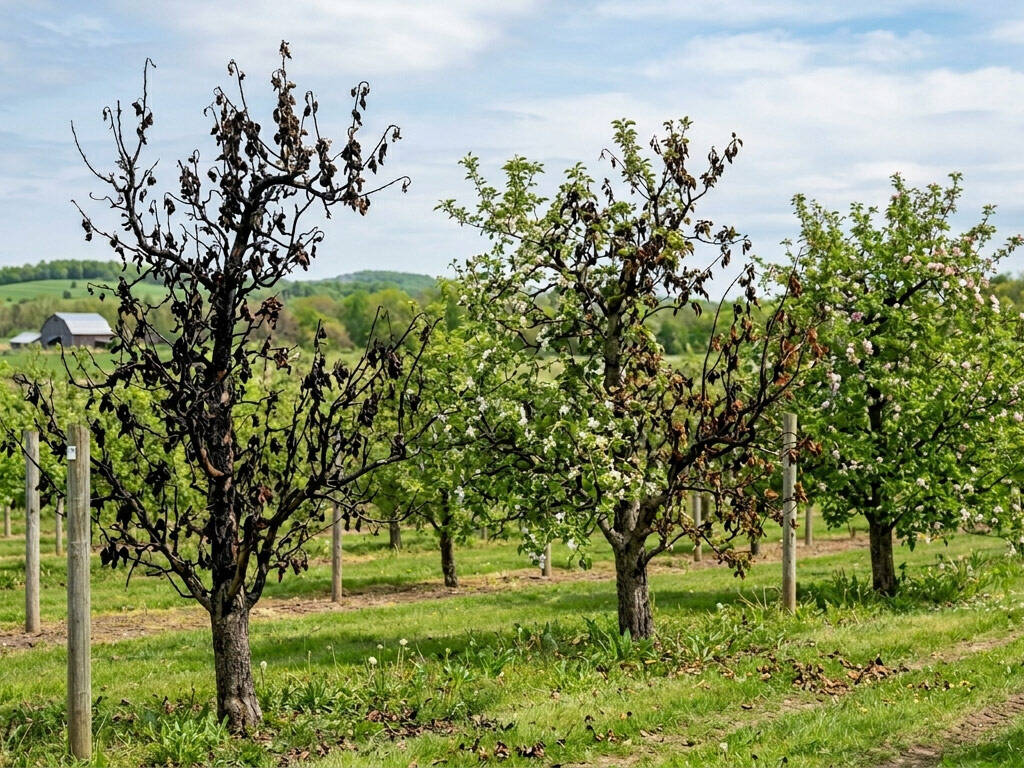
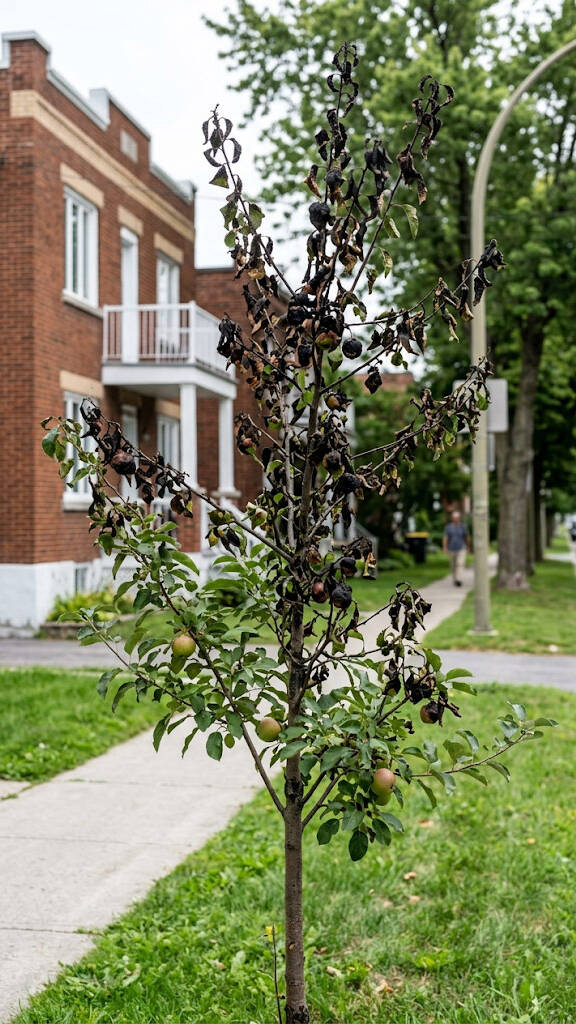
- Scorched Appearance: Leaves and flowers turn brown or black and appear water-logged before drying out. Unlike normal leaf drop, these “scorched” leaves often remain tightly attached to the branch.
- Bacterial Ooze: During humid spells, you may see a sticky, amber-colored liquid seeping from infected bark. This liquid is teeming with bacteria and attracts insects that further spread the disease.
- Late-Season Cankers: By late summer, the infection can move into larger branches and the main trunk, forming sunken, cracked areas of bark (cankers).
3. Tactical Management: How to Deal with an Infection
If you detect Fire Blight, “wait and see” is not a viable strategy. You must act decisively to prevent the bacteria from reaching the trunk.
- Precision Pruning: Remove infected branches immediately. You must cut into healthy wood at least 30 to 50 cm (12 to 20 inches) below the lowest visible sign of damage.
- Strict Sanitation: This is where most DIY efforts fail. You must sterilize your pruning tools with a 70% isopropyl alcohol solution between every single cut. Failure to do so will simply “vaccinate” the rest of the tree with the disease.
- Debris Disposal: Never compost infected wood. Rake up all fallen leaves and fruit, and dispose of all diseased parts far away from healthy trees.
4. The Best Defense: Prevention and Resilience
An ounce of prevention is worth a pound of cure, especially with a disease that has no effective biological or low-impact pesticide “reset button”.
- Choose Resistant Varieties: When planting, select cultivars known for their resilience. For example, the ‘Rouville’ apple tree is highly resistant to fire blight and hardy to our Zone 3 climate. Other resistant options include ‘Enterprise’ and ‘Liberty’ apples, or ‘Golden Spice’ and ‘Summercrisp’ pears.
- Control Growth: Avoid high-nitrogen fertilizers. These encourage rapid, succulent “water sprout” growth, which is extremely vulnerable to bacterial entry.
- Soil and Site Management: Ensure trees are planted in well-drained soil and avoid overhead watering, which splashes bacteria from leaf to leaf.
Master Arborist Tip: Because Fire Blight moves through the tree’s conductive vessels, it can reach the rootstock and kill the entire tree if left unchecked. If you notice cankers on the main trunk, the tree may pose a significant structural risk and should be evaluated by a professional immediately.
Master Arborist Tip: Because Fire Blight moves through the tree’s conductive vessels, it can reach the rootstock and kill the entire tree if left unchecked. If you notice cankers on the main trunk, the tree may pose a significant structural risk and should be evaluated by a professional immediately.

Related Posts

What is Proper Tree Planting?
We’ve all seen it: a beautiful new tree is planted in a front yard, only to die…
Understanding Eutypella Canker in Your Maples
Maple trees are the crown jewels of many landscapes, and are present in…